Vegetable Uttapam
A classic, wholesome, and comforting breakfast staple from South Indian cuisine. Unlike a paper-thin, crispy dosa, an uttapam is a thicker, fluffier pancake crafted from a naturally fermented rice and urad dal lentil batter, with fresh vegetables and green chilies pressed directly into the dough while searing.
Free, no account needed.
Did you cook it? Add your photo
So it lives in your cookbook with your story, not mine.
Add my photo
35 min
India del Sur
4 servings
The story behind
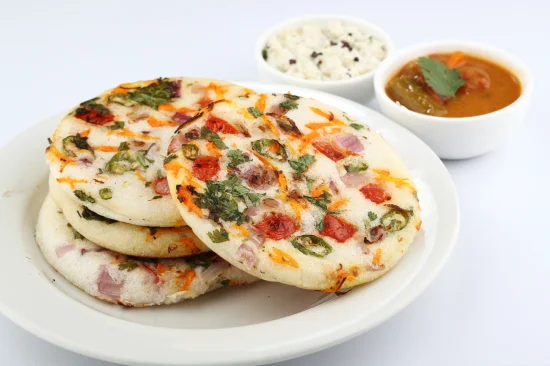
The vibrant and immaculate composition inside the file "Uttapam.png" perfectly honors the daily breakfast canvas of Southern India. Stacked beautifully on a clean white ceramic plate, a tower of four fluffy, perfectly round uttapams takes center stage. Their pale, soft rice base contrast brilliantly with a mosaic of colorful embedded toppings: bright red diced tomatoes, crisp chopped red onions, strands of grated orange carrots, round slices of fresh green chilies, and flecks of fresh coriander leaves. In the background, the traditional meal is rounded out beautifully by two white side bowls: one holding a thick, textured coconut chutney dotted with black mustard seeds, and another containing piping hot sambar, a deeply aromatic lentil and vegetable stew garnished with a fresh coriander leaf. The soul of a great uttapam lies in the natural fermentation of its batter, which yields an airy, sponge-like interior and a signature tangy undertone that cuts through the fresh crunch of the vegetables.
Instructions
-
1Prepare the vegetable medley: finely chop your red onion, deseeded tomato, and fresh cilantro, grate the carrot, and slice the green chilies into thin rounds. Keep them in separate small bowls or toss them gently together with a tiny pinch of salt.
-
2Ensure your fermented dosa/uttapam batter is at room temperature. If the batter is too thick, stir in a couple of tablespoons of water; it should be a thick, easily pourable consistency—noticeably heavier than thin crepe batter.
-
3Heat a large non-stick griddle or an Indian cast-iron tawa over medium heat. Season the surface lightly by rubbing it with a paper towel dipped in a few drops of vegetable oil.
-
4Ladle a generous, heaped scoop of batter (about half a cup) directly into the center of the hot griddle.
-
5Using the back of the ladle, spread the batter gently in a slow outward circular motion. Keep it thick—an authentic uttapam should be about 6 to 8 mm (1/4 inch) deep, unlike a flat dosa.
-
6Immediately, before the wet batter begins to cook through, grab a generous handful of the vegetable mixture and scatter it evenly across the entire surface of the pancake, matching the beautiful, crowded layout seen in the file "Uttapam.png".
-
7Using a flat silicone spatula, gently press the toppings down into the wet batter. This anchors the vegetables so they don't fall off when flipped.
-
8Drizzle a teaspoon of vegetable oil or melted ghee all along the outer edges of the pancake and a few drops over the exposed vegetables.
-
9Cook over medium-low heat for about 2-3 minutes. You will know it's ready to flip when tiny steam holes and bubbles perforate the batter surface and the edges turn a pale golden color.
-
10Deftly slide your wide spatula underneath and flip the uttapam over. Cook vegetable-side down for another 1-2 minutes, pressing lightly so the onions and tomatoes catch a light, sweet caramelized char against the heat.
-
11Flip once more to ensure everything is cooked through, then slide it onto a serving plate.
-
12Repeat with the remaining batter and vegetable portions. Stack the finished uttapams warm on a plate, and serve hot next to bowls of steaming lentil sambar and cool, fresh white coconut chutney to perfectly recreate your image file's experience.
Share this recipe
Rate this recipe
Sign in to the app to rate
You might also like
🍊
Save this recipe to your Zest
Add photos when you cook it, write your story, and share it with a Moment Card.
Create my free account